
Thank you! A crew lead will contact you within one business day.
Pool Deck Paving & Resurfacing in Palm Beach County | Paving Commandos
Cool-to-the-touch, slip-resistant pool deck surfaces engineered for Florida's relentless UV exposure — installed with precision by Palm Beach County's paving specialists. Our surfaces stay comfortable barefoot even in peak summer heat, and decorative polymer sealants lock in color against South Florida sun degradation.
GET A FREE QUOTE
Expert Pool Deck Installation Engineered for South Florida Conditions
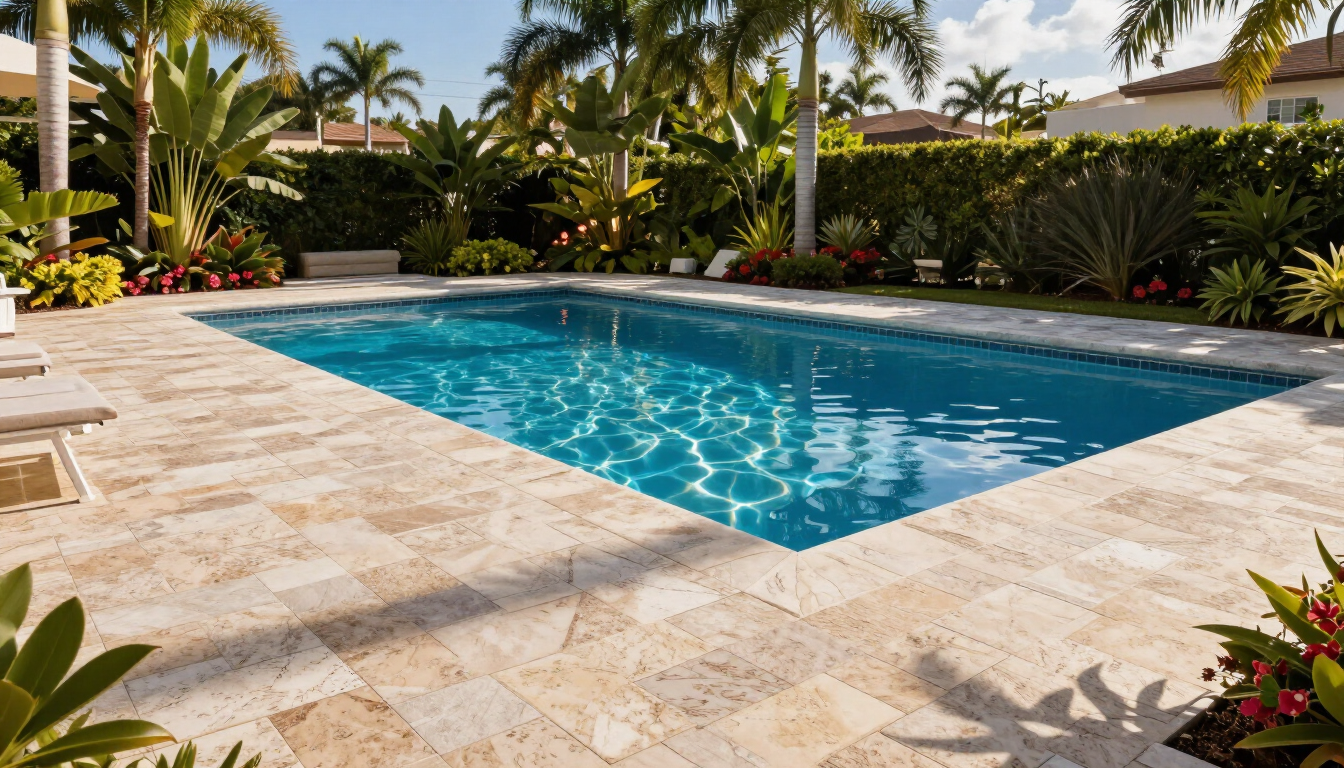
Slip-Resistant Aggregate Finishes: Paving Commandos specifies broadcast aggregate and exposed pebble finishes with ANSI A326.3 dynamic coefficient of friction (DCOF) ratings above 0.42 for wet conditions, meeting the minimum standard for pool surround safety. Aggregate gradation is calibrated to the specific paver or concrete mix to prevent bridging voids that trap moisture and harbor mold.
Pool-Edge Coping Paver Details: Bullnose and tumbled-edge coping pavers are set with a full-bed mortar system on a reinforced concrete bond beam, with 3/8-inch open joints back-pointed with a flexible, non-shrink grout rated for continuous pool-water contact. Overhang dimension — typically 1 to 1.5 inches — is sized to drip water clear of the pool shell wall.
Thermal Expansion Joint Placement: Compressible backer rod and polyurethane sealant expansion joints are placed at maximum 10-foot intervals around pool perimeters, and at every structural transition — deck-to-coping, deck-to-house slab, deck-to-equipment pad — to accommodate Florida's extreme diurnal temperature swings and prevent reflective cracking in the field slab.
Decorative Polymer Sealant for UV Resistance: A two-coat penetrating acrylic-polyurethane sealant system is applied after full cure — minimum 28 days for poured concrete; 72 hours for paver joints to set. UV-stabilized pigment carriers resist color shift under South Florida's UV index 11+ summer exposure, and the sealant bridges hairline micro-cracks, repels chlorinated water, and restores the surface color without forming a high-gloss film that would reduce wet traction.
Drainage Slope Requirements: All pool deck surfaces are finished to a minimum 1/8-inch-per-foot slope away from the pool coping and toward perimeter drains or bio-swales, per Palm Beach County stormwater management standards — ensuring standing water is eliminated within minutes of rain or splash events.
Why Palm Beach County Pool Owners Choose Paving Commandos
A professionally installed paver or concrete pool deck combines safety engineering with resort-level aesthetics. Every Paving Commandos pool deck project is spec'd to perform under Florida's specific sun, humidity, and storm conditions for decades.
- Cool-Surface Technology: Lighter-toned pavers and reflective sealants keep barefoot surface temps measurably lower than dark asphalt or unsealed concrete under direct sun.
- Fade-Resistant Sealant Systems: Two-coat UV-stabilized acrylic-polyurethane sealants maintain color integrity through 10+ years of UV index 11+ South Florida exposure.
- ADA-Compliant Slip Ratings: All surfaces meet or exceed DCOF 0.42 wet-condition thresholds, satisfying ADA accessibility guidelines for pool surrounds.
- Travertine Paver Option: Natural travertine's thermal mass stays cooler than poured concrete and provides timeless Mediterranean aesthetics valued in Palm Beach luxury markets.
- Brick Paver Option: Interlocking clay or concrete brick pavers allow individual unit replacement if root intrusion or settlement causes isolated damage — no full-deck tear-out.
- Stamped Concrete Option: Custom stamped and stained concrete decks replicate the look of natural stone, tile, or wood plank at a lower material cost with a monolithic structural surface.
- Thermal Expansion Joints: Properly spaced compressible joints prevent the reflective cracking common on competitor decks that skip this step in Florida's heat cycles.
- Drainage Engineering: Minimum 1/8-inch-per-foot slopes engineered into every layout to eliminate standing water and reduce slip hazard after rain or splash.
Pool Deck Technical Specifications
Every Paving Commandos pool deck is engineered to the following minimum performance specifications. Material selection and mix design are adjusted to Palm Beach County's alkaline soil conditions, high water table, and seasonal chlorinated splash exposure.
| Specification | Concrete Pool Deck | Paver Pool Deck | Resurfacing Overlay |
|---|---|---|---|
| Material Thickness | 4 inches minimum (6 in. at edges) | 2.375-inch paver + 1-inch sand setting bed + 4-inch compacted base | 3/8-inch to 1/2-inch polymer-modified topping |
| PSI Strength | 4,000 PSI minimum (ASTM C94) | Paver unit: 8,000 PSI+ (ASTM C936); Base slab: 3,000 PSI | Overlay bond strength: 1,200 PSI tensile (ASTM C1583) |
| Average Lifespan | 25-35 years with proper sealing | 30-50 years (individual unit replaceable) | 10-15 years before re-coat |
| Typical Curing Time | 28 days full cure; foot traffic at 72 hours | 24-48 hours (sand sets; no cure wait for pavers) | 24 hours foot traffic; 72 hours full service |
| Sealing Requirement | Every 3-5 years (acrylic-polyurethane) | Every 3-4 years (penetrating sealer + joint sand refresh) | Every 2-3 years (overlay re-coat) |
| Slip Rating (DCOF Wet) | 0.42+ (broadcast aggregate finish) | 0.50+ (tumbled or brushed paver face) | 0.42+ (polymer aggregate broadcast) |
| Expansion Joints | At 10-ft. intervals + all structural transitions | At paver field perimeter + coping bond beam | At overlay perimeter + existing control joints |
Our Pool Deck Installation & Resurfacing Process
From initial site assessment through final inspection, Paving Commandos executes every pool deck project to a disciplined multi-phase process — minimizing pool downtime, ensuring structural integrity, and delivering a finished surface that passes Palm Beach County building inspection on the first submission.
Step 1: Site Assessment & Demolition Planning
The crew evaluates existing slab thickness, subgrade condition, drainage slopes, and pool shell integrity before any demolition begins. For resurfacing, existing concrete is tested for delamination with a sounding hammer — hollow areas are mapped and marked for spot removal. For full replacement, hydraulic saw-cutting and pneumatic demolition equipment are used to remove the existing deck without transmitting vibration stress to the pool shell.
Step 2: Subgrade Compaction & Base Preparation
Exposed subgrade is compacted to 95% Proctor density using a plate compactor, with a minimum 4-inch compacted crushed limestone base applied for paver installations or a vapor-retarder membrane laid for poured concrete decks to manage South Florida's high water table. Base grades are set to achieve the finished 1/8-inch-per-foot drainage slope before any material is placed.
Step 3: Paver Setting or Concrete Pour
For paver decks, a 1-inch compacted bedding sand layer is screeded to final grade and pavers are laid to the approved pattern, with 1/16-inch to 3/32-inch joint spacing for polymeric sand. For poured concrete decks, a rebar reinforcement matrix (typically #4 bar at 18-inch centers) is placed on 2-inch chairs, the perimeter forms are set, and 4,000 PSI concrete is placed and consolidated with an internal vibrator to eliminate cold joints and air voids.
Step 4: Coping Installation
Bullnose or tumbled-edge coping pavers are installed on a reinforced concrete bond beam using a full-bed polymer-modified mortar at the approved overhang dimension (1 to 1.5 inches past the pool shell wall). All coping-to-deck and coping-to-tile line transitions are back-pointed with a flexible, pool-water-rated polyurethane sealant to prevent chlorinated water migration.
Step 5: Sealant Application
After achieving minimum cure (28 days for concrete; 72 hours for paver joint sand to fully set), two coats of UV-stabilized acrylic-polyurethane sealant are applied by low-pressure spray and back-rolled to ensure uniform mil thickness. The second coat is applied at 90 degrees to the first to eliminate lap lines. A broadcast anti-slip aggregate is incorporated into the second coat to maintain DCOF wet ratings.
Step 6: Final Inspection & Client Walkthrough
All expansion joints are inspected for full sealant continuity. Drainage slopes are verified with a digital level. The completed surface is reviewed with the client, documenting the sealing schedule and care instructions for Palm Beach County's specific climate conditions. Any punch-list items are resolved before the project is signed off.
Serving Premier Pool Deck Markets Across Palm Beach County
Paving Commandos delivers expert pool deck paving and resurfacing services across Palm Beach County. Our crews are active in two of the region's most prominent luxury pool markets — and we bring the same precision-grade installation to every project regardless of location.
Boca Raton Pool Decks
From Royal Palm Yacht & Country Club estates to waterfront condos along A1A, Paving Commandos installs travertine, brick paver, and stamped concrete pool decks that match Boca Raton's luxury property standards.
Jupiter Pool Decks
In Jupiter's coastal neighborhoods and golf course communities, our UV-resistant sealant systems and slip-rated aggregate finishes are specified for pools that see year-round use under South Florida's intense sun.
Ready to Upgrade Your Pool Deck?
Contact Paving Commandos today to schedule a free on-site assessment and receive a detailed, no-obligation quote for your pool deck project in Palm Beach County.
Pool Deck Services Across Palm Beach County
Paving Commandos dispatches pool deck installation and resurfacing crews throughout Palm Beach County — from Boca Raton and Boynton Beach in the south, through West Palm Beach, to Jupiter and Riviera Beach in the north. Call 561-473-1302 to confirm availability in your neighborhood.
Pool Deck FAQ — Palm Beach County
Get quick answers to the most common pool deck paving questions from Palm Beach County property owners. Have a question not listed? Call Paving Commandos at 561-473-1302.
How does South Florida's UV exposure cause pool deck color fading, and how do you prevent it?
Palm Beach County's summer UV index regularly reaches 11 or higher — well above the threshold that degrades standard acrylic sealants within two to three seasons. Paving Commandos specifies UV-stabilized acrylic-polyurethane sealant systems with carbon-black and inorganic pigment carriers that resist photodegradation. The sealant is applied in two cross-directional coats to uniform mil thickness, eliminating the thin spots where color shift begins. Even with this system, Florida's climate requires re-sealing every three to five years to maintain both color integrity and the protective barrier against chlorinated water penetration.How often does a pool deck need to be sealed in Florida's climate?
For poured concrete pool decks, Paving Commandos recommends re-sealing every three to five years using a penetrating acrylic-polyurethane sealer — more frequently for pools with heavy bather loads or automated chlorine systems that create aggressive splash chemistry. Paver pool decks should be re-sealed every three to four years, with a polymeric sand joint refresh at the same interval to prevent weed intrusion and ant tunneling in the sand bed. Resurfacing overlays carry a shorter cycle of two to three years due to the thinner material cross-section. All sealing timelines are accelerated by South Florida's combination of UV radiation, salt air (in coastal zones), and frequent wet-dry cycles.What texture and pattern options are available for pool decks, and which is best for barefoot comfort?
Paving Commandos offers travertine pavers (the most popular luxury choice in Palm Beach County due to their natural thermal mass and Mediterranean aesthetics), interlocking brick or concrete pavers in running bond, basketweave, or herringbone patterns, and stamped concrete in slate, flagstone, cobblestone, and wood-plank profiles. For barefoot comfort in direct sun, lighter-toned travertine and cream-colored concrete pavers are strongly recommended over dark-toned or black surfaces, which can reach 140°F+ on an exposed South Florida deck in July. All texture options are specified to achieve DCOF wet ratings above 0.42 for slip safety around pool water.How quickly can a resurfaced pool deck be used after curing?
A polymer-modified resurfacing overlay is typically ready for foot traffic within 24 hours of application under normal Palm Beach County ambient conditions (75-95°F, relative humidity below 80%). However, the overlay reaches full service strength — meaning furniture placement and pool chemical splash — at 72 hours. For poured concrete new decks, foot traffic is permitted at 72 hours but furniture and heavy use should be deferred until 7 days, with the sealant application window opening at full 28-day cure. Paver decks can typically be walked on within 24 to 48 hours of polymeric sand installation, as the pavers themselves require no curing — only the joint sand needs to set. Paving Commandos provides a written project timeline with all cure milestones before work begins so pool access disruption is minimized.
Upgrade to a Resort-Quality Pool Deck — Get Your Free Quote Today
Your pool deck is the most-used outdoor surface on your property. Don't let cracked, faded, or slippery concrete undercut your outdoor living investment. Paving Commandos brings Palm Beach County homeowners precision-installed, UV-resistant, slip-rated pool deck surfaces — poured concrete, travertine, brick paver, or stamped — backed by meticulous craftsmanship and detailed project documentation. Call us now or submit your free quote request and a crew lead will contact you within one business day.